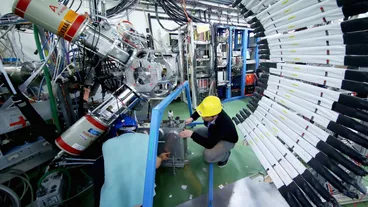
One problem is that women still think of engineering as dull and male-centric. There is a pervasive image of grease, hard hats and building sites. But our research shows that girls are prepared to engage with engineering given the right motivation. They are also interested in the relatively high salaries that can be achieved in the sector, and why not?
Yesterday was, for many physicists (and physics students), as a friend put it, "a bit like Christmas", and I think it is safe to bet that quite a few at CERN woke up today with a very Christmassy hangover. But, now that the party is over, a question arises (as often on the morning after): what exactly did happen yesterday?
In a couple of days, the final results on the search for the Higgs at CERN will be publicised, so in the meantime, I would like to dwell a bit on what comes after. Indeed, if the Higgs is found, this will only have confirmed, once more, that the Standard Model of Particle Physics was right, and was able to predict the existence of a new, exotic particle.
This Nature blog post reports on some possible sources of error that may rule out the problem of the superluminal neutrinos reported by the OPERA team earlier in September 2011.
Since the Large Hadron Collider has been closed for a while, and experiments concerning the search for the Higg's and other hot topics such as the "faster than light neutrinos" (there is still no firm evidence as to the validity of the results, hence the quotes) are not due to start again until March, in the meantime I would like to take advantage of the break to talk briefly about one of physics most interesting concepts: entropy!