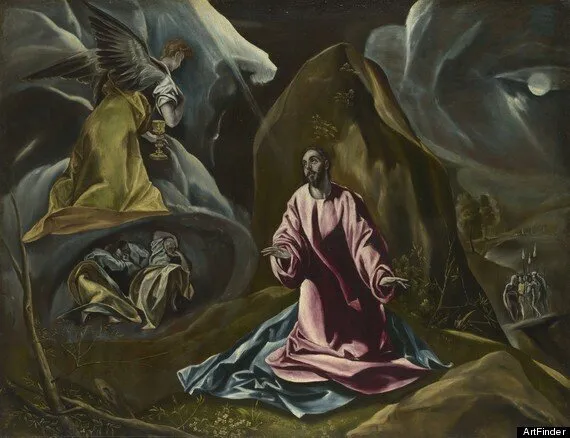
'The Agony in the Garden of Gethsemane' by El Greco (1590)
El Greco's The Agony in the Garden of Gethsemane tells the story of the first event in the story of Christ's Passion, or the Easter Story. The Agony in the Garden refers specifically to the events between Christ's Last Supper and his arrest that led to the Crucifixion; here we can see Christ praying at Gethsemane before accepting his sacrifice.
During his agony, Christ - who can be seen kneeling in the centre - was accompanied by the three apostles St Peter, St John and St James the Greater, who can be seen sleeping in the cave behind him. He prayed to God that his burden would be lifted, "My Father, if it is possible, let this cup pass me by. Nevertheless, let it be as you, not I, would have it." He was then strengthened by an angel who came from heaven, and who can be seen on the top left of the painting holding a cup, a reference to his forthcoming Passion. Judas approaches on the far right, heading towards the garden where he would then give Christ a kiss to identify him to the soldiers that accompany him, and who then arrest him.
Artyfacts:
- Philip II, King of Spain commissioned El Greco to paint an altarpiece of The Martyrdom of St Maurice then sacked the artist and had Romulo Cincinnato paint a replacement.
- El Greco once heavily criticised The Last Judgment painted by Michelangelo on the walls of the Sistine Chapel.
- Picasso's revolutionary work Les Demoiselles d'Avignon was perhaps an homage to El Greco's The Opening Of The Fifth Seal.
This painting is considered to be one of El Greco's most important and exemplifies his Mannerist style, which emerged in the late Renaissance in Europe. Mannerism celebrated artistic imagination over more naturalistic depictions of the physical world; here, facial features are distorted, the figures are thin and elongated and the artist uses rich, vivid colour, or 'acid' colour as it is sometimes referred to. Furthermore, the composition is complex - in comparison to Renaissance painting, El Greco does not choose a harmonious composition, but uses many elements that lead our eye away from the central Christ figure. These features give the painting an otherworldly feel, an artificial sense of space, which increase the emotional intensity and drama of the scene.
This style of painting is considered to have been influential in the development of modern art, where artists began experimenting with distorted space and perspective, more abstract composition and less realistic depictions of the human form.
You can learn more about El Greco's practice and works at Artfinder. And discover the story of Christ's Passion through art in this collection from Artfinder. Happy Easter!
Jen Bayne, Artfinder