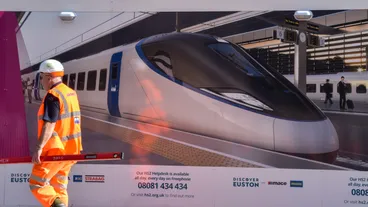
The news last week about a proposed high speed rail link in the UK resulted in numerous bulletins containing reports from middle England that were all seemingly variants on a theme.
We NIMBYs have plenty of reasons for objecting to the London-Birmingham High Speed Rail Link. It cuts a motorway-wide swathe through 150 designated nature sites, including ten SSIs and four nature reserves, without adequate consultation.
Imagine boarding a train in Birmingham that will zip to London in less than an hour. By 2026 the government hopes this will become a reality with the building of a brand spanking new high-speed rail link from Birmingham to London, courtesy of the tax-payer of course.
David Cameron has hailed it as the "biggest modernisation of our railways since the Victorian era". But we really shouldn't get too carried away about the government's £9.4bn programme of investment in the railways announced today, or believe it will do much to alleviate our transport problems.
We've had another bout of high speed rail bashing today. Margaret Hodge's Public Accounts Committee (PAC) implies that the case for HS2 - the proposed new 225mph line from London to Birmingham and beyond - is flawed. They think that the line could end up costing taxpayers like you and I much more than we've bargained for.
Back into recession, austerity yet to fully bite, pressure from backbenchers, the Opposition and world leaders - the Government needs to take bold action to show that austerity and growth can go together.
Infrastructure is a hot topic at the moment and hit the headlines again today when Ken Livingston rejected the idea of a new airport for London in the Thames estuary. Livingston's view on this particular project is another example of the single-mindedness of politicians across the world.
It has long been accepted that infrastructure development is a vital piece of the growth puzzle. David Cameron certainly subscribes to this mantra, having put infrastructure at the heart of his growth strategy when he outlined a huge £30bn investment over the next four years.
The UK government has been talking about building a new airport in the Thames estuary for over 30 years. And every time a new plan is put forward, it's been rejected -- for very good reasons.
Once again the media has become excited about proposals for a new London airport following reports that ministers are warming to the idea.
Even the most hardened of political anoraks might have missed the fact that something rather important happened this week, indicating the direction of travel for the Labour Party. It came in a speech by Ed Miliband. It is centred on a fact that few have recognised: We can no longer afford to subsidise the private sector.
It staggers me and most Scots that David Cameron and indeed the whole London commentariat could possibly have thought his proposed "deal" to have a speedy binding Scottish referendum - or nothing - would be greeted in Scotland as anything other than a stale bit of last week's bread fit only to be chucked straight back over the fence.
I challenge all those politicians who support HS2 to go out onto the streets and ask real people to choose between spending £17 billion on reducing the journey time for wealthy rail passengers between London and Birmingham by 23 minutes and all the other things we could do for that pot of money.
So the high speed London to Birmingham train will cost £32 billion. I presume that's return. It'll probably be cheaper to buy two singles. Still, I can't help thinking that David Cameron's new compromised route speaks volumes...
There have always been those opposed to progress. But we're not talking about the Galileo or the Industrial Revolution here - we're talking about 40 minutes off the journey between London and Birmingham - at a cost of £17 billion of public money! And, when no-one can be quite sure of the scheme's success, it does all seem like a little too high a price to pay.
Sadly the idea of building a high speed rail line from North to South is in the news again. The idea is to spend £30bn or so building a new line from London to Birmingham. This will cut journey times, and increase capacity.